
In the Indo-Pacific's new era -- where perception shapes reality faster than treaties -- the real entrapment is not of China or the United States. It is the test Japan has set for itself -- and whether partners like India, acting as balancers rather than accelerants, can help ensure that the story ends in stability, points out Varun Arya.

The enduring relationship between the two countries have survived the disintegration of the erstwhile USSR in 1991, the end of the Cold War and the regime change in both countries, points out Rup Narayan Das.
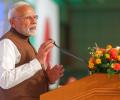
Showcasing India as an attractive investment destination, Modi said the country has political and economic stability as well as transparency and predictability in policy decisions.

With Pakistan obviously on his mind, Prime Minister Manmohan Singh warned on Tuesday, of the dangers posed by nuclear explosives falling into the hands of non-state actors posing danger to India and other countries. Addressing the Nuclear Security Summit in Washington, he pitched for "zero tolerance" against individuals and groups which engage in illegal trafficking of atomic explosives and announced India's decision to set up a 'Global Centre for Nuclear Energy Partnership'.
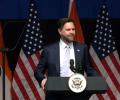
US Vice President JD Vance called on India to drop non-tariff barriers, give greater access to its markets and buy more American energy products and military hardware. Vance, in a speech in Jaipur, highlighted the need for a stronger US-India partnership for a prosperous and peaceful 21st century. He emphasized the importance of working together to address global challenges and praised Prime Minister Narendra Modi, describing him as a "special person." Vance also urged India to provide greater market access to American products and buy more defense platforms and energy from the US. He suggested that India consider dropping some of the non-tariff barriers for American access to the Indian market and highlighted the benefits of closer India-US defense collaboration, advocating for New Delhi to procure more military hardware from the US. He cited the example of American fifth-generation F-35s, arguing they would give the Indian Air Force the ability to defend its airspace and protect its people like never before. Vance also welcomed the Modi government's budget announcement to amend India's civil nuclear liability laws, paving the way for US producers to export small modular reactors and build larger US-designed reactors in India. He emphasized the importance of energy security for India's AI ambitions, stating "there is no AI future without energy security and energy dominance." Vance's visit comes amid growing global concerns over the US's tariff war.

United States President Donald Trump reiterated the claims of having to do 'something' about Greenland, saying that if US doesn't take any action, Russia and China would spring in and that Washington, DC does not want to have them as neighbours.

India and Canada have unveiled a roadmap to boost cooperation in trade, critical minerals, and energy, signaling efforts to rebuild strained relations following the killing of a Sikh separatist in 2023. Discussions include addressing concerns over pro-Khalistan elements and pursuing a balanced partnership.

The deal would allow Japan to export nuclear technology to India.
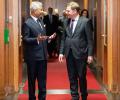
External Affairs Minister S Jaishankar has asserted that India has zero tolerance for terrorism and will never give in to nuclear blackmail, emphasizing that New Delhi will deal with Pakistan purely bilaterally. He made these remarks during a joint press conference with his German counterpart in Berlin, where he also highlighted the importance of the strategic partnership between India and Germany, emphasizing the need for a free trade agreement between the two nations.

'Trump is good news for us. Energy poverty is real, and fossil fuels are the answer.'

Although the credit for acquiring the technological skill must be given to India's outstanding nuclear scientists, the decision to go nuclear was a political one that entailed clarity of vision, courage and resolve, points out Rup Narayan Das.
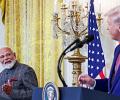
Prime Minister Narendra Modi and US President Donald Trump have vowed to move forward with plans to work together to build US-designed nuclear reactors in India. The decision was made during their meeting at the White House, where they also agreed to significantly expand energy cooperation. The move comes after India announced plans to amend its nuclear liability law and the Atomic Energy Act, which had previously been obstacles to the implementation of the US-India civil nuclear deal.
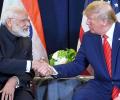
It would be the prime minister's first bilateral visit to the US after Trump became president for a second term.

Prime Minister Manmohan Singh on Friday batted for nuclear power as a "dependable and clean option", even as he underlined the need to ensure that all ingredients by which nuclear fuel is made remain safe and do not fall in the hands of terrorists and anti-social elements.
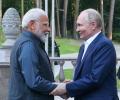
The Indian government is dealing with the matter having in mind the national interests of this country in the first place, he said.

The crises of the 21st century, 9/11, the economic meltdown, COVID-19, Russia-Iran war and the Hamas-Israel war seem to be never ending. In this situation, Iran might be contemplating a nuclear deterrent to defend itself, observes Ambassador T P Sreenivasan, the distinguished long-time Rediff contributor who turns 80 on June 17..
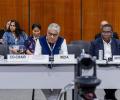
India will publish its revised Nationally Determined Contribution (NDC) for the 2035 period by December, Environment Minister Bhupender Yadav said on Monday, while urging developed nations to achieve net zero targets ahead of their current timelines.

The formulations in the declaration in reference to terrorism is going to be to our "satisfaction", Dammu Ravi, secretary (economic relations) in the external affairs ministry said on Monday.

Senior officials from India and the US engaged in virtual talks to discuss bilateral ties, focusing on trade, investment, critical minerals, and energy security, including civil nuclear cooperation.
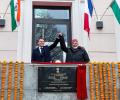
Prime Minister Narendra Modi and French President Emmanuel Macron have called for enhancing trade and investment ties between their countries and committed to further deepening their engagement in the Indo-Pacific. They discussed a full spectrum of bilateral relations, including key global and regional issues, and stressed the urgent need for reform in the United Nations Security Council. The leaders also underscored their commitment to ensuring the global AI sector can drive positive social, economic, and environmental outcomes.

'Within 30 minutes of when Asim Munir made those comments, he should have been taken to Tampa airport and flown out of the United States.'

Prime Minister Narendra Modi condemned the violation of Qatar's sovereignty following Israeli air strikes on Doha, targeting Hamas leaders. He conveyed India's deep concern to the Emir of Qatar and reiterated support for peace and stability in the region.

The exit of Larsen & Toubro (L&T) from the Hyderabad Metro is a long-term positive for the stock. It could be a bullish trigger, alongside higher international orders, and new opportunities in segments like defence and data centres.
On the eve of his visit to Tokyo, Prime Minister Manmohan Singh has said that he hopes to strengthen strategic and global partnership with Japan and reach an early agreement with regard to civil nuclear energy cooperation.

'What we need to watch is how Saudi Arabia's financial assistance will be used by Pakistan. If the funds go to build their military hardware and operations, it should worry us.'

'Our problem is not a budget deficit but a trust deficit. We need to trust our institutions and industries to innovate and lead. That is the way forward for India.'
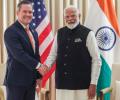
Prime Minister Narendra Modi said he had a 'fruitful meeting' with United States National Security Advisor Michael Waltz and they discussed defence, technology and security areas, which are important aspects of the India-US ties.
While the capital spending is being maintained at 3.1 per cent of the GDP, a little more would have boosted economic growth even further, suggests Rajiv Memani.
Under the radar, Manmohan Singh and Barack Obama made a great deal of progress in resolving outstanding bilateral issues around climate change.

TotalEnergies will acquire 25 per cent shareholding in Adani New Industries Ltd -- the firm that houses Adani Group's new energy business -- for an undisclosed amount, the two firms said in separate statements. "TotalEnergies has entered into an agreement with (Adani Group's flagship) Adani Enterprises Limited (AEL) to acquire a 25 per cent interest in ANIL," the French energy giant said.

The agreement will form the basis of wide-ranging bilateral cooperation from basic and applied research to full civil nuclear cooperation, including reactors, nuclear fuel supply, nuclear safety, radiation and environment protection and nuclear fuel cycle management, officials said. The nuclear agreement and the social security pacts were signed after the Summit meeting between Prime Minister Manmohan Singh and French President Nicholas Sarkozy at the Elysee Palace in Paris.
Reflecting their desire to deepen the strategic partnership, India and Germany have for the first time discussed the possibilities of entering into bilateral cooperation in civil nuclear energy.
Backing Iran's right to peaceful uses of nuclear energy, India has said that "no country can put pressure" on Tehran in that respect as it sought establishment of strategic partnership with the oil-rich Persian country.

Modi praised the contribution of nuclear scientists in the successful implementation of India's three-stage nuclear programme.

During the talks with Prime Minister Narendra Modi, French President Francois Hollande reassured reliable, uninterrupted and continued access to nuclear fuel supply throughout the entire lifetime of the plants while acknowledging India's need for the same.
India and Argentina on Wednesday signed an agreement in civil nuclear cooperation and nine other pacts with a desire to establish strategic partnership.
'America is adopting the typical 'my way or the highway'/'Either you are with us or against us' stance.' 'This is a policy India is not going to accept.'
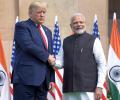
Prime Minister Narendra Modi will pay a two-day working visit to the US from February 12 during which he will meet President Donald Trump, the external affairs ministry announced. The visit will give further impetus and direction to India-US bilateral relationship. Prior to his US visit, Modi will be in France from February 10-12 to co-chair the AI Action Summit with French President Emmanuel Macron. He will also visit Cadarache, the site of the International Thermonuclear Experimental Reactor of which India is a partner. During his visit to France from February 10-12, Modi and Macron will also address the India-France CEOs forum. The prime minister and Macron will travel to Marseille where they will inaugurate the Consulate General of India. The leaders will also visit the war cemetery and pay tribute to the sacrifices made by Indian soldiers in World War 1. Modi and Macron will visit Cadarache, the site of the International Thermonuclear Experimental Reactor (ITER). There has been a very close rapport between Trump and Modi, dating back to the US leader's first term. There is a clear convergence of interests between the two countries in several areas, including trade, investment, technology, defense cooperation, counterterrorism, Indo-Pacific security, and people-to-people relations.
'We note the commitments India has made... We look forward to reinforcing our partnership with India,' said the document issued by the US, Russia, France, UK, Italy, Germany, Canada and Japan.
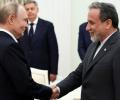
Will Russia's entry deter Trump on his warpath?, asks Ambassador M K Bhadrakumar.
